
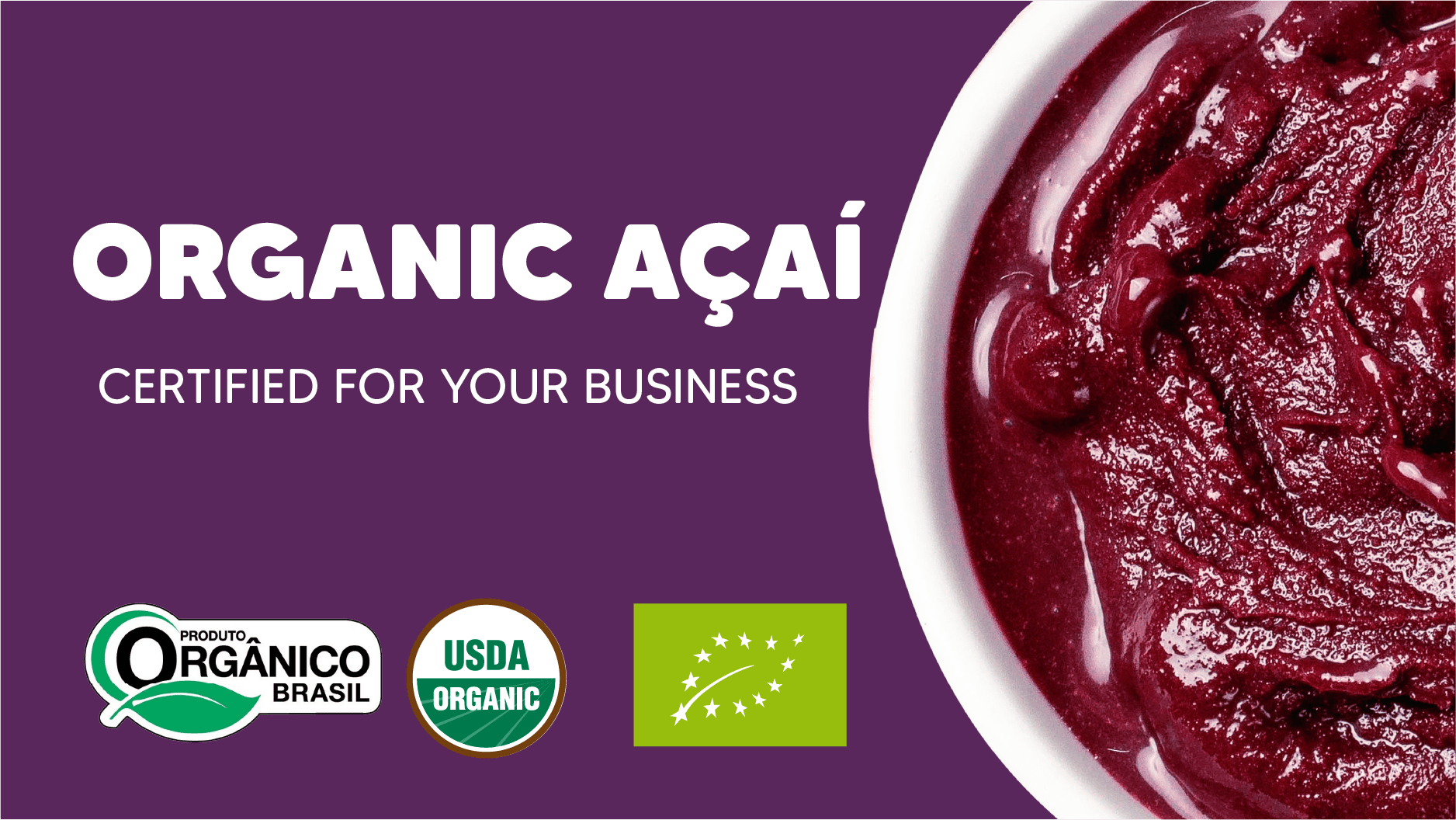
The consumption of organic foods is gaining more and more space around the world. Consumers, importers, and distributors are increasingly attentive to the origin of food, the traceability of the production chain, and how the product reaches the final consumer, all while maintaining flavor and quality.
Açaí, a fruit native to the Amazon region, is generally associated with natural products and a healthy lifestyle. According to The World of Organic Agriculture 2025 report, published by FiBL and IFOAM, global sales of organic food and beverages exceeded 136 billion euros in 2023, while the global organic agricultural area reached nearly 99 million hectares. This shows that organic products are not just a consumer trend: they represent a consolidated direction in the international market.
Product with Organic Certification
A certified organic product is one that has undergone evaluation by a recognized and accredited certification body, following specific standards for production, processing, storage, transportation, and labeling.
In Brazil, the Ministry of Agriculture and Livestock states that organic production must comply with specific technical rules for different areas, including plant production, sustainable extractivism, and the processing of products of plant origin.
In the United States, for example, each shipment of imported organic agricultural products must be associated with a NOP Import Certificate, issued by a certification body accredited under the USDA system. This requirement became mandatory under the rules for strengthening organic enforcement implemented in 2024.
In the European Union, all imported organic products require an electronic certificate of inspection. In addition, controls must be carried out by bodies recognized by the European Commission.
In practice, for a cream, sorbet, or açaí-based product to be marketed as organic, it is not enough to use the word “organic” on the label. It is necessary to prove the conformity of both the product and the production chain, respecting the scope of certification and the requirements of the destination country.
Certification Required in Some Countries
In many countries, certification is not treated as a competitive advantage, but as a requirement. Countries such as the United States and members of the European Union require this certification in order to import products.
Açaí Town, always up to date with market trends and ready to deliver everything its clients need with the highest quality, holds this certification. For importers, organic certification reduces commercial risks and facilitates negotiations with markets that require documentary proof. For consumers, it conveys trust in the product and its quality.
Açaí Town operates in exports and has an international presence in more than 40 countries, with relevant experience in export operations, delivering organic-certified açaí-based sorbet to all its clients. This makes its product aligned with the healthy market, its requirements, and the appropriate documentation for international private label shipments.
Açaí Town: from the Amazon to the world, now also with organic certification for new markets.