
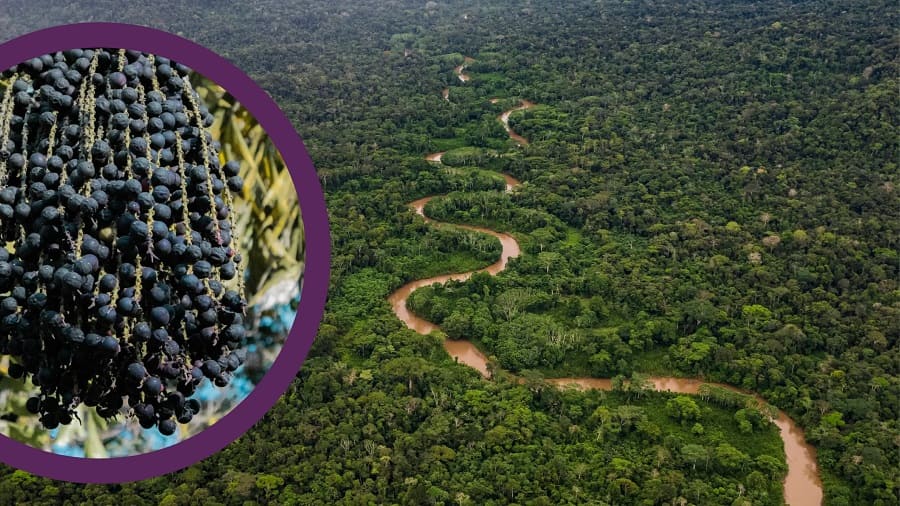

When someone asks “where does açaí come from,” the answer seems simple at first glance: the Amazon. But in practice, that answer opens the door to a much richer universe of territories, species, and flavors that many people still don’t know.
Far beyond the Amazon: the leading role of Pará
Açaí is native to the Amazon region, one of the most biodiverse biomes on the planet. However, when it comes to large-scale production and recognized quality, it’s impossible not to highlight the state of Pará.
Today, Pará is responsible for about 90% of Brazil’s açaí production. Cities such as Igarapé-Miri, Abaetetuba, and Belém are references in the cultivation and processing of the fruit. A large portion of the açaí consumed both in Brazil and internationally comes from there.
In other words, although açaí is Amazonian by essence, the açaí that reaches you most often originates from Pará.
Not all açaí is the same: different species
Another lesser-known point is that “açaí” is not a single standardized fruit. There are different species and variations that directly influence flavor, texture, and nutritional value.
Among the main ones, we can highlight:
Black açaí (Euterpe oleracea)
The most common and widely consumed. It has an intense, slightly earthy flavor and a high content of anthocyanins — the antioxidants responsible for its dark color.
White açaí
A rarer variation, with a lighter color and a milder, less pronounced flavor. It is highly appreciated regionally but not widely known outside Northern Brazil.
Single-stem açaí and clump-growing açaí
These classifications are related to how the palm tree grows. The “single-stem” grows in isolation, while the “clump-growing” type grows in clusters. This can impact productivity and even subtle characteristics of the fruit.
Early-harvest açaí (or “precocious” varieties)
Refers to varieties that produce fruit earlier in their cycle, playing an important role in maintaining supply throughout the year.
These variations exist due to factors such as soil, climate, cultivation practices, and plant genetics — which means two açaí fruits can have completely different profiles, even if they come from the same region.
The taste of the territory
The açaí traditionally consumed in Northern Brazil is quite different from the version popularized in the rest of the country. While in the Southeast and South it is usually sweeter and served with fruits and toppings, in Pará consumption is more traditional: pure, with farinha (cassava flour), or even paired with savory dishes.
This difference is not only cultural — it also comes from the raw material. Açaí from Pará tends to be denser, less diluted, and with a more authentic flavor.
One fruit, multiple identities
Understanding where açaí comes from also means understanding that it is not a single product, but a universe of possibilities.
From the heart of the Amazon to the riverbanks of Pará, each fruit carries its own characteristics — a direct result of nature, cultivation, and local culture.
And perhaps that’s what makes açaí much more than a global trend: above all, it is an expression of Brazilian biodiversity.
Sources:
IBGE (Vegetal Extraction and Forestry Production – PEVS); EMBRAPA (studies on açaí cultivation and species); SciELO (scientific articles on composition and fruit variations); academic research from Amazon-region universities such as UFPA and UFRA.